
Guide · Babies 0–1
Thailand with a baby: arrival, feeding, heat, mosquitoes and doctors
Thailand is manageable with a baby: diapers are sold in every 7-Eleven, formula is on supermarket and pharmacy shelves, and private hospitals are used to foreign families. Plan around three things: a car seat for the ride from the airport, heat and sun, and daytime mosquitoes that carry dengue.
Updated · Health advice from the CDC; entry rules from Thai immigration
How do you arrive in Thailand with a baby?
Fill in the Thailand Digital Arrival Card for every traveler, the baby included, within the 3 days before you land. Use only the official site, tdac.immigration.go.th: the card is free, and look-alike sites charge for it. One submission can include up to 10 people, so one parent can file for the whole family.
Then book the ride to your hotel before you fly. Airport meter taxis cannot be reserved with a child seat, and taxis are exempt from the car seat rule, so a pre-booked transfer is the simple way to have a seat waiting. On the Smile Taxi Service network, the seat is requested when you book (100 THB per seat on the regional sites), the first 60 minutes of waiting at the airport are free, and a person checks your flight. The meeting point is confirmed with your booking. From Suvarnabhumi Airport (BKK) to central Bangkok takes about 45–60 minutes.
Booking a seat for a baby
Give the baby's age, weight and height, say whether you need a rear-facing seat, and ask for the seat to be confirmed in writing. No operator can promise a specific infant seat, so if a rear-facing seat is essential for you, bring your own. See taxis with car seats for every network site by region.
What should you pack, and what can you buy in Thailand?
Pack the things your baby is fussy about and anything medical; buy the bulky everyday items after you land. Diapers and wipes are easy to find, including the BabyLove brand at 7-Eleven, and in Boots, Watsons and supermarkets such as Tops, Big C, Lotus's and Central.
| Item | In Thailand? | Our advice |
|---|---|---|
| Diapers and wipes | Everywhere, including convenience stores | Pack a few days' worth, buy the rest |
| Infant formula | Supermarkets and pharmacies; convenience stores carry mostly toddler milk | Bring your usual brand, especially for small islands |
| Medicines and thermometer | Pharmacies, but brands and doses differ | Bring what your pediatrician recommends, with dosing notes |
| Insect repellent | Widely sold | Ask your pediatrician which product suits your baby's age |
| Car seat | Request one with each transfer | Bring your own if you will rent a car or use taxis |
| Travel cot | Ask the hotel | Request it when booking the room, in writing |
| Carrier and light stroller | Available in city malls | Bring your own; you will use the carrier most |
Thai law has banned the advertising and promotion of infant formula since 9 September 2017, but not its sale, so do not expect special offers or in-store displays.
How do you keep a baby cool in the Thai heat?
Keep outings for the cooler hours, before about 10:00 and after 16:00, and spend the middle of the day indoors or in the shade. The hot season, from mid-February to mid-May, is the hardest time for babies; the cool season, from mid-October to mid-February, is the easiest.
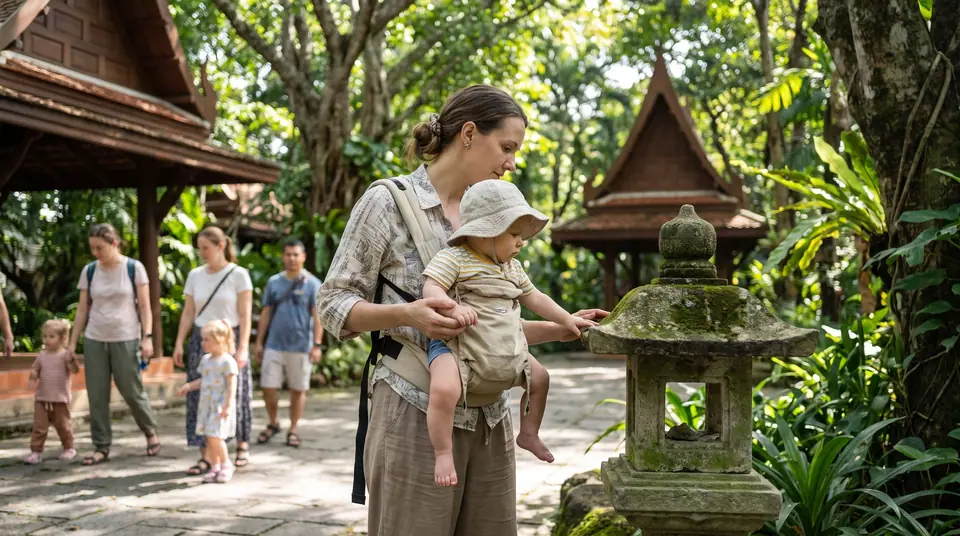
- Dress the baby in light, loose clothing and a wide-brimmed hat, and keep them out of direct sun.
- Offer feeds more often in the heat; fewer wet diapers than usual is a sign to act.
- Check car seats and stroller surfaces that have stood in the sun before you put the baby in.
- Never leave a baby in a parked car, even for a minute.
How do you protect a baby from mosquitoes and dengue?
By avoiding bites during the day: the mosquitoes that spread dengue bite in daylight. Dengue occurs throughout Thailand all year, with a peak in the rainy season, roughly May to October. Thailand's Department of Disease Control counted 21,620 cases and 31 deaths from 1 January to 19 August 2026.
- Cover arms and legs with light clothing, and use a mosquito net over the stroller and the cot.
- Choose rooms with air-conditioning or window screens.
- Use a repellent your pediatrician has approved for your baby's age.
- See a doctor promptly if your baby has a fever during or after the trip, and mention the travel.
There is no dengue vaccine for babies. Malaria pills are not needed for Bangkok, Chiang Mai or Phuket; the CDC recommends them only for rural forested border areas.
What about feeding and drinking water?
The CDC advises travelers not to drink tap water in Thailand. Use bottled or filtered water for formula and for rinsing bottles, and carry a sealed bottle on every outing. For babies on solids, plain rice, eggs, soup, bananas and mango are easy to find; ask for dishes without chili by saying "mai phet" (not spicy).
Will hotels provide a cot?
Many family hotels can, but ask when you book, get the answer in writing, and check the cot when you arrive: sturdy sides, a firm mattress that fits, nothing loose inside. An air-conditioned room with blackout curtains makes naps much easier in the heat.
Stroller or baby carrier?
Bring both if you can, and expect to use the carrier more. Bangkok's pavements are often uneven, narrow or blocked, many Skytrain stations and temples have stairs, and beaches and island paths are hard going on wheels. A light, folding stroller is useful in airports, malls and hotel grounds and for naps; a soft carrier works on boats, in markets and at temples.
What if your baby gets sick in Thailand?
For an emergency, call 1669 for an ambulance. For anything less urgent, the large private hospitals in Bangkok, such as Bumrungrad International, Samitivej and Bangkok Hospital, see many foreign patients and have English-speaking staff; outside Bangkok, look for the private hospitals in provincial capitals and resort areas. These are examples, not endorsements, and private care is expensive without insurance.
Vaccinations
Check your baby's routine vaccinations with your pediatrician well before you travel. The CDC lists routine vaccines, including measles (MMR), for everyone, hepatitis A for unvaccinated travelers from age 1, and hepatitis B, typhoid, Japanese encephalitis and rabies depending on the child, the length of stay and the activities. If you arrive from a country with yellow fever, a vaccination certificate is required from 9 months of age; the vaccine is not recommended for Thailand itself.
Insurance
Make sure your travel insurance names the baby and covers hospital treatment and medical evacuation. Keep the policy number and the insurer's emergency line on your phone and on paper.
Pick one or two bases. With a baby, a single hotel with a pool, shade and a nearby supermarket beats a new place every two nights. Hua Hin and Koh Samet are the easiest beach bases from Bangkok; the best time to visit is the cool season.
Transparency: Smile Taxi Service and its regional transfer sites are affiliated with Thailand 4 Kids. Everything we say about them comes from the operator's published terms.
Frequently asked questions
Can I buy baby formula in Thailand?
Yes. Infant formula is sold legally in supermarkets and pharmacies; only advertising and promotion are banned. The range of brands is narrower than at home and thin on small islands, and convenience stores mostly stock toddler milk, so bring enough of your baby's usual formula.
Are diapers easy to find in Thailand?
Yes. Diapers and wipes are sold in 7-Eleven and other convenience stores, in Boots and Watsons, and in supermarkets such as Tops, Big C, Lotus's and Central. Pack enough for the journey and the first day or two.
Does a baby need a Thailand Digital Arrival Card?
Yes. Every non-Thai traveler needs a TDAC for each entry, babies included. It is free on the official site and must be filed within the 3 days before arrival; one submission can cover up to 10 people.
What is the best time to take a baby to Thailand?
The cool season, mid-October to mid-February, is easiest for heat. The rainy season, mid-May to mid-October, brings the dengue peak, so be strict about mosquito protection if you travel then.
Is a stroller useful in Bangkok?
Partly. A light folding stroller helps in airports, malls and hotels, but pavements are uneven and many stations and temples have stairs, so most parents rely on a carrier in the city.
Can we take a baby to Thai beaches?
Yes, with shade, a sun hat and the middle of the day spent indoors. Gentle, shallow beaches within a short drive, such as Hua Hin, are easier than islands that need long transfers and boat crossings.
Sources
- Travelers' Health: Thailand — US Centers for Disease Control and Prevention (CDC), checked 27 Sep 2026
- CDC Yellow Book 2026: Thailand — CDC, checked 27 Sep 2026
- Thailand Digital Arrival Card FAQ — Immigration Bureau, checked 27 Sep 2026
- Questions and answers on Thai visas (passport validity) — Ministry of Foreign Affairs, checked 27 Sep 2026
- New law bans infant formula advertising — The Nation, 18 Aug 2017, checked 27 Sep 2026
- Baby diapers category — Tops (Central Food Retail), checked 27 Sep 2026
- Dengue cases and deaths in 2026, citing the Department of Disease Control — The Thaiger, 26 Aug 2026, checked 27 Sep 2026
- Thailand's tourist assistance contact numbers — Government Public Relations Department, checked 27 Sep 2026